Sewer in Leeds: Why the Sudden Urgency?
By Michelle Peot
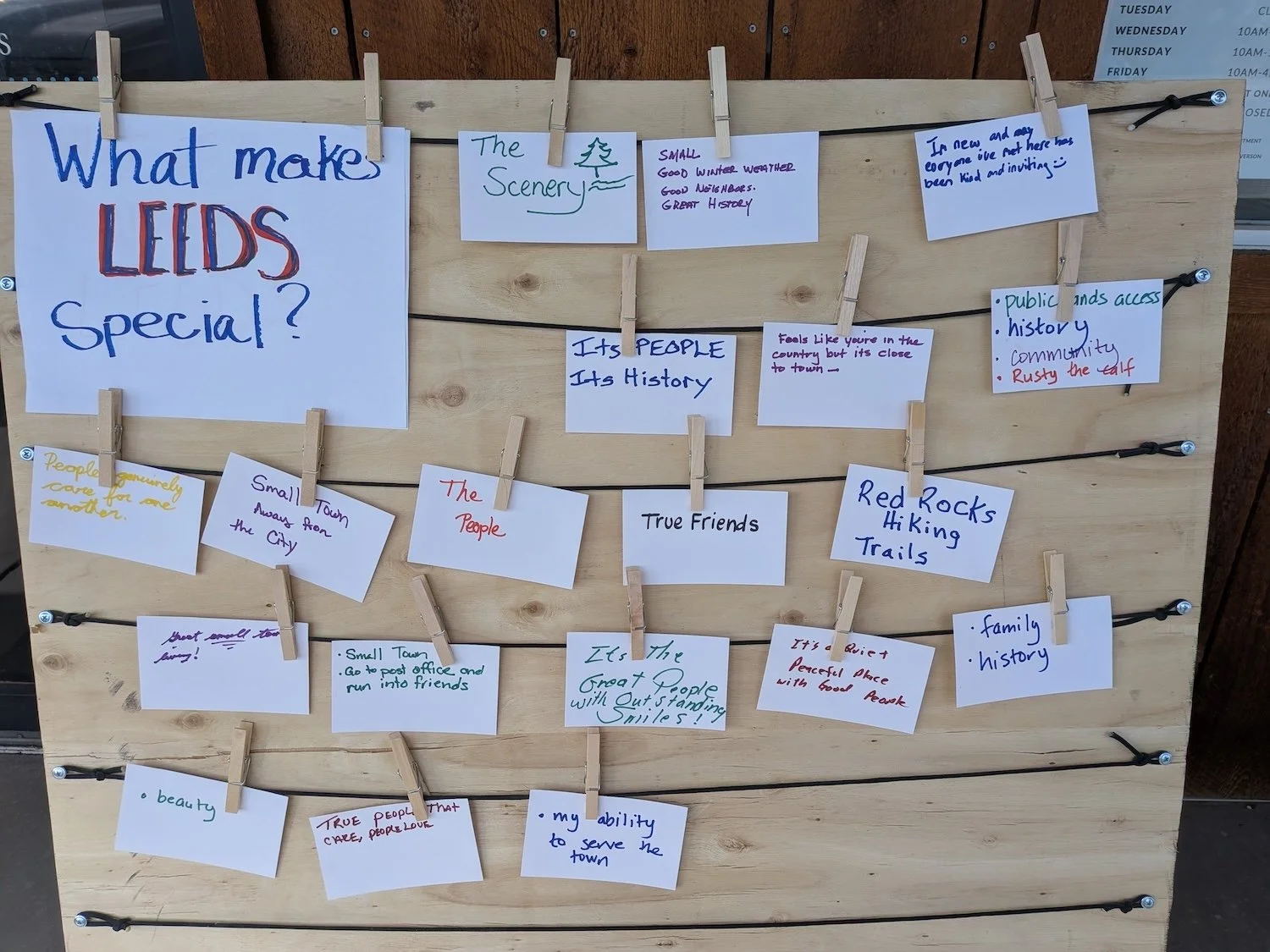
Info collected from people in town just before the election
Intro
Leeds has been one of the final Washington County hold outs for sewer, and for good reason. There are substantial financial implications for residents. The global infrastructure costs are estimated in the $5-8 million range, plus roughly $5,000-10,000 per household to tie into the sewer line and a monthly service fee. So why has Leeds Town Council been repeatedly asked over the past year to fast track sewer proposals without sufficient due diligence around costs versus benefits?
History of wastewater management in WashCo and Leeds
Septic system densities in Washington County were determined through a 1997 groundwater risk analysis by Hansen, Allen & Luce (a.k.a. the HAL Study), as documented in Determination of Recommended Septic System Densities for Groundwater Quality Protection. A representative from each affected town, including Leeds Councilmember, Jean Thornton, participated in the project steering committee. Based on the analysis, septic system densities were established for each municipality and the county.
For Leeds a default density of 1 septic system per 9 acres was applied, with existing plats grandfathered in. For newer plats not meeting the septic density requirement, wastewater must be handled through an alternate onsite or regional wastewater treatment system, as required by the health department as part of the building permit process. More information can be found on the Washington County Water Conservancy District's wastewater page.
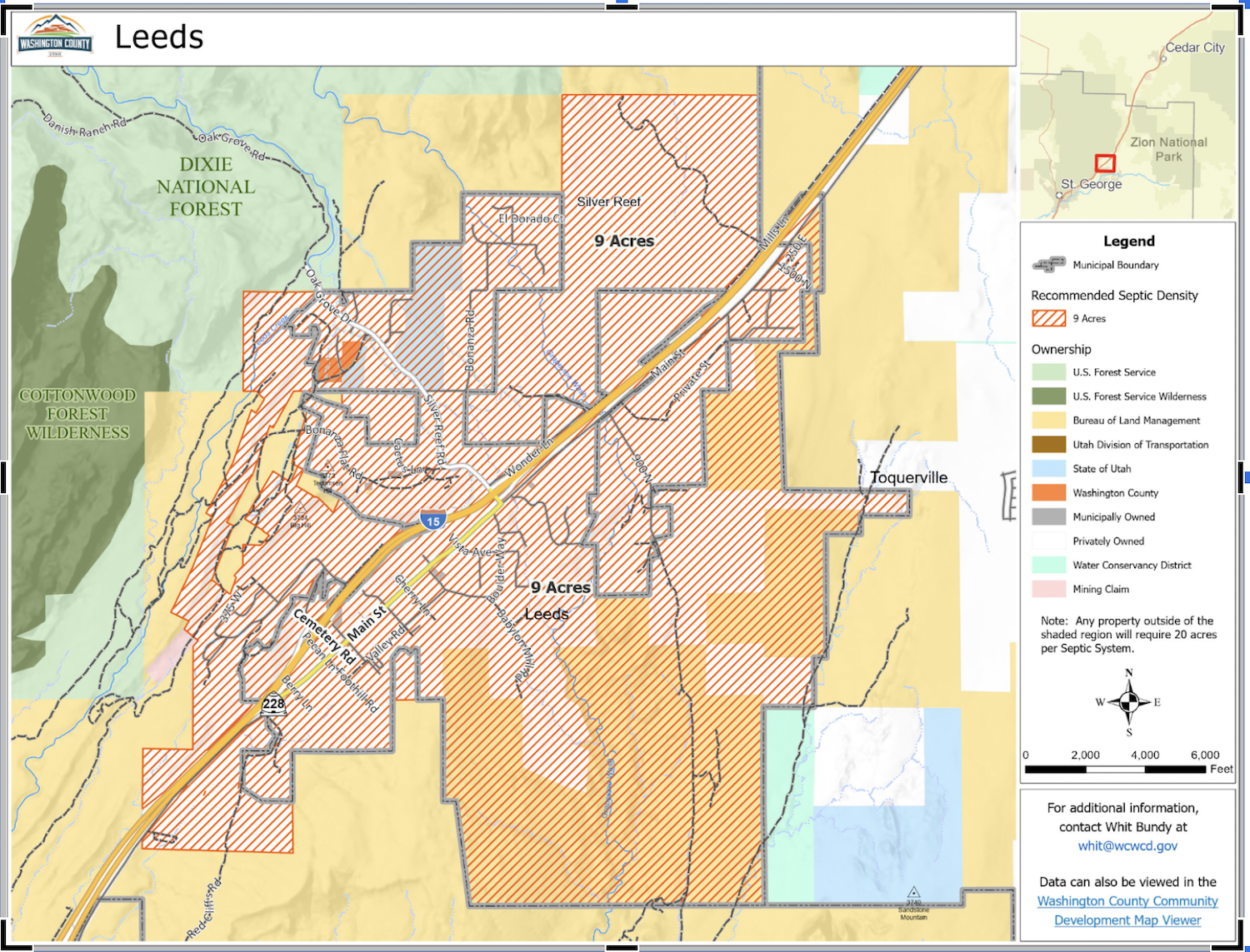
Map of Leeds finalized septic system density from the 1997 HAL Study. A 1 septic system per 9 acres or alternate wastewater treatment system is enforced for newer plats.
Over the years, sewer has been proposed to Leeds by multiple developers to enable higher density. Residents have pushed back largely due to the cost, and the proposals have been voted down.
Why Leeds' water situation is unique
As the sustainability of water resources has become more concerning, the Washington County Water Conservancy District (WCWCD) has made water service delivery contingent upon sewer in order to recapture the wastewater for reclamation and treatment. Leeds Domestic Waterusers Association (LDWA), the primary provider of culinary water in Leeds, does not share this requirement. Today, LDWA serves drinking water to the vast majority of Leeds residents, but it does not have the water to serve the proposed larger developments. As a town, we need to better understand how WCWCD, LDWA, and Ash Creek fit together, and be thoughtful in considering decisions that will have major financial and service delivery impacts on residents and LDWA shareholders.
Why the lack of financial and meeting transparency?
A year ago at the December 11, 2024 Town Council meeting, Paul Morris, Silver Cliffs development representative, presented a draft joint resolution for Leeds to partner with Silver Cliffs and Ash Creek Special Services District. The resolution was vaguely worded, and no information was provided on the substantial financial cost to the town and residents. One councilmember stated that "there wasn't time" to do a cost/benefit analysis, and we needed to just sign it. After Councilmembers Kohl Furley, Danielle Stirling, and I pushed back, the resolution was not brought to a vote. Silver Cliffs ultimately ended up partnering directly with Ash Creek SSD.
Fast forward to ten months later when on October 22, 2025 Mike Chandler, the representative from Ash Creek Special Services District (SSD), Washington County's sole large-scale sewer provider, was brought in as the only guest for a Town Council work meeting whose sole agenda item was publicized as "Washington County Water Conservancy District". The complexities of our water provider situation were discussed, and it was agreed that should the town desire to move forward, a more nuanced agreement with Ash Creek SSD should be drafted to ensure that infrastructure costs and impact fees were fairly distributed. To date, no draft has been circulated.
Last week, on December 5 2025, a draft proposal with the seemingly benign title of Draft Amendment to Regional Water Supply Agreement Adding Leeds as a Municipal Customer was circulated for the December 10th Town Council meeting. The proposed amendment includes a clause that forces the town to finalize a sewer agreement with Ash Creek SSD by the end of the 2025, realistically 2 working weeks away.
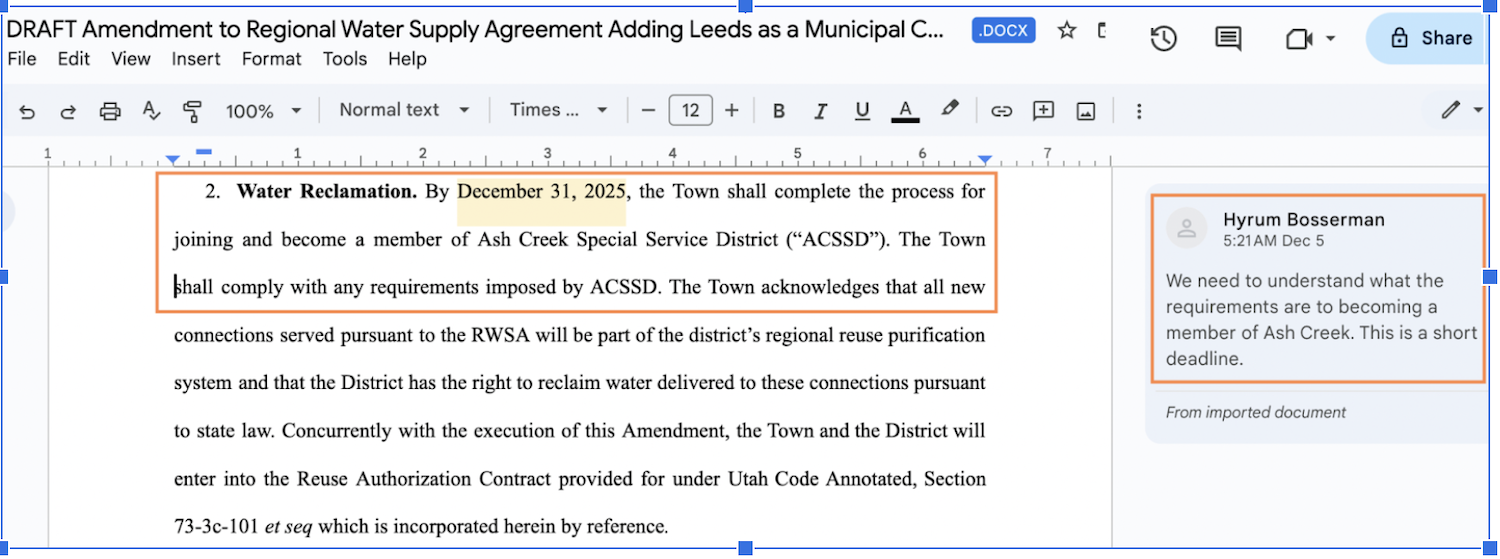
Excerpt from the Draft Amendment to Regional Water Supply Agreement Adding Leeds as a Municipal Customer, including Leeds legal council's concerns
How much would it cost?
At the October 22nd meeting, Mike Chandler from Ash Creek SSD provided some sobering numbers.
Global infrastructure costs
The town would be responsible for covering the cost of design and global infrastructure, at a rough estimate of $5-8 million. If the state covers this through a grant, loan or combination thereof, no variances are allowed for grandfathering in legacy septic systems. If this comes in the form of a loan, the town would likely also have to pay interest. If a private institution handles the loan, an existing homeowner could petition to opt out of the forced integration; however, the loan interest rate would likely be higher.
If the funding is not in the form of a grant, property owners would be on the hook through increased property taxes. Even if developers help cover the global costs to serve their development, Ash Creek SSD recommends that the system be upsized for future expansion. This incremental cost would likely have to be provided by the town.
Incremental homeowner costs
In addition to any increased property taxes, each resident whose property lies within 300 feet of a sewer line would be required to tie into the sewer line. Based on today's impact fees, that would be $3,100 per homeowner, plus the cost to run the line from the edge of the property to home, likely pushing costs into the $5,000-10,000 range. In addition, residents would pay a monthly service fee (currently $36 per month), plus any costs to maintain the line to their home.
If the state funds the global infrastructure, residents would not be allowed to petition to opt out due to financial hardship. Even if a homeowner was granted a financial hardship variance, Ash Creek traditionally recommends the following rules to end the variance:
If a septic system has a catastrophic failure
The home is sold
A 10-year expiration timeline
Why the renewed urgency?
There are less than 3 weeks left in December, a month that traditionally has only a single Town Council meeting. Only a single member of the Leeds administration, Councilmember Kohl Furley, will be continuing on in 2026. No draft agreement with Ash Creek SSD has been provided, and Leeds legal council, Hyrum Bosserman, raised concerns about the timeline in his own comments.
There are no developments in immediate need of sewer, so why the urgency?
Who should decide?
Given the cost to taxpayers and individual property owners, the only just way to move forward with sewer is with a town ballot measure.