fire, water, & more
by lori cole
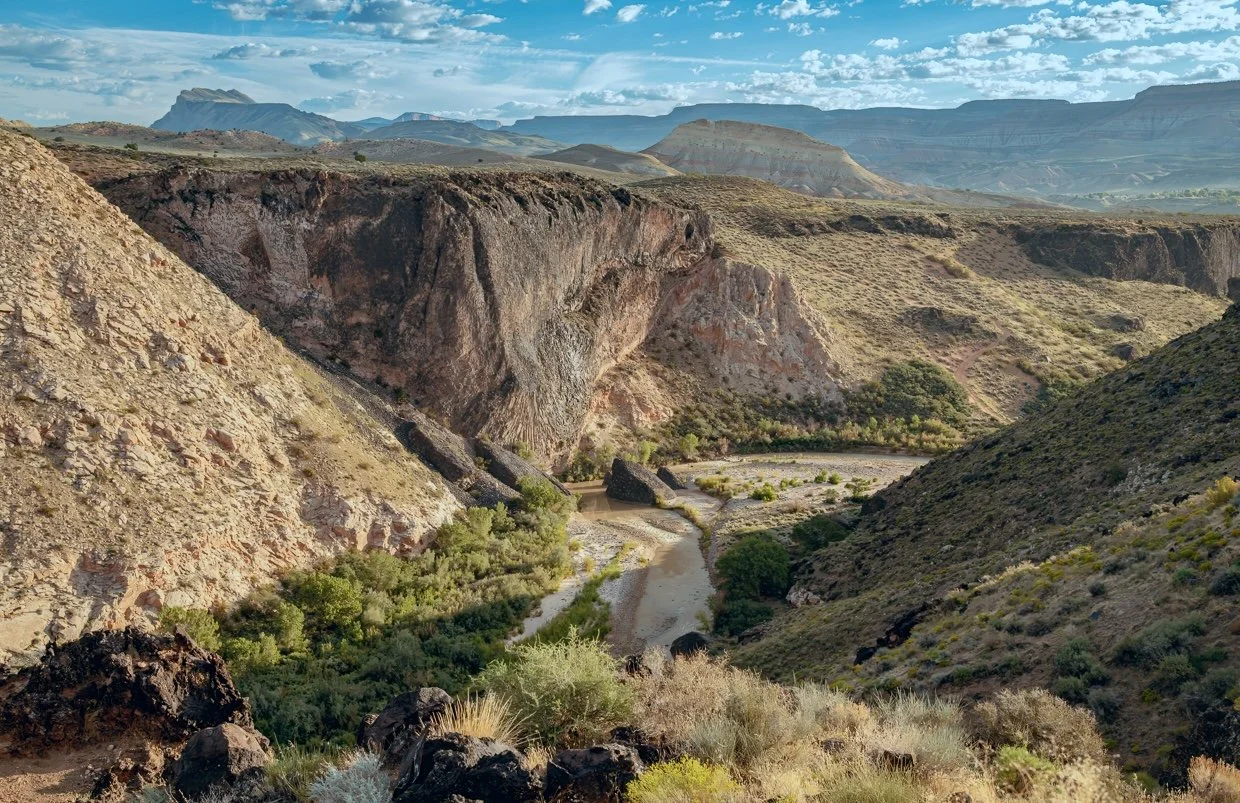
Above the Virgin River by Lori Cole
This was an incredibly long, mind-numbing meeting. I admit to having a difficult time recapping the January 21 meeting for you because some of the content made me angry. I will alert you up front that there is some sarcasm included, so proceed at your own risk. Sorry, not sorry.
City Expenditures
City Expenditures from Dec 2025: Review & Approval – Tabled until next meeting due to questions from council member Olson.
Public Comments
A citizen asked if land is being set aside for churches (LDS, specifically) with all the new residential lots (1000+) being approved recently.
Business Items
Nightly Rental
Vote on the nightly rental application for Willow Ln (zoned as single-family residential): Since citizens didn’t voice opinions against approval and the Planning Commission suggested approval, the nightly rental application was approved.
Utility Code
City Utility Code: Just a question of the wording of the code. Roll call vote – approved.
Wildland Urban Interface code
Adopting Wildland Urban Interface Code (WUI) established in 2025 by Utah legislature in HB48. Get ready for a wild ride, as this took up a large amount of the multi-hour meeting:
In short, City Manager Ben explained that the State of Utah has mandated that the city adopt the code as written. If Toquerville doesn’t adopt the code, the city will be solely responsible for the cost of fighting all wildfires in the city that otherwise would have been paid for by the state. The Council ultimately voted to adopt the code, with one council member (Wayne Olson) voting against.
The rest of the story:
Toquerville property owners will be forced to pay a fee* to Washington County of between $20 to $100 for administrative costs. (I believe the fee defaults to $100 unless you get a reduction by complying with whatever they say must be done on your property to reduce the alleged “risk.”)
The $100 fee from Washington County for the WUI administration costs would have been billed to residents even if our council had NOT voted to adopt the ordinance. The County will be sending property owners a bill, and if property owners don’t pay it, the amount of the fee will be added to their yearly property taxes.
*IMPORTANT: The fee will not be used to fight wildfires. It will pay for administrative costs, which, no doubt, will continue at an ever-increasing rate as administrative costs tend to do. We have just allowed another entity to be created to charge us even more of our hard-earned but seemingly “unlimited” funds.
Another Note: A glance at the WUI map of Toquerville reveals that about 99% of Toquerville properties have been designated “high risk.”
Even Better News: Representatives of this WUI agency will be visiting your homes and assessing your properties. I know, I am excited about this too (sarcasm alert). You will be able to reduce your yearly fee by doing what they say, for one example: cutting down/trimming trees, or possibly getting rid of your lawn. If you don’t follow their suggestions, you will have to pay the full assessment. Just call them the “Lawn Police” which is what I will be doing.
I, for one, will be upset if my neighbors decide to cut down their trees to save money. We already live in a sparse, desert landscape. How much sparser can we possibly be required to make it without destroying our beautiful community? I thought trees were a thing in Toquerville? I was told when my home was built here years ago that I was required to plant at least two trees. Maybe the landscaper lied to me.
I hope someone will put in the time to find out exactly how we got here, why the legislature voted for HB48, who is responsible for the WUI map, what their criteria was, if there are facts to back up their assessment, and who benefits. I bet we find that the insurance lobby and insurance companies are the answers to those questions.
How many of you have already been dropped by your insurance company because they consider you to be in a “high risk wildfire zone?” I have personally had one company refuse to cover my property for that exact reason, and I only have 5 small trees and no grass. How about you? Even Mayor Catlin reported that he had his home insurance canceled because of the map declaring him in a high-risk wildfire area. I can envision that we will see more of this, not to mention higher rates if you find a company to insure you.
WHY IS TOQUERVILLE CITY HIGH RISK? I don’t accept the assessment, and I don’t agree with it. Now, convince me otherwise. I want facts, not virtue signaling. NONE of us wants our community to end up like The Palisades, so don’t even try that. Explain why we have the same risk. PS: You know this is also related to why our power goes out so often now, even in the middle of summer when it’s over 100 degrees...it is a policy that the power companies here were mandated to follow because of what happened in California. Again, why are we letting that horribly mis-managed state dictate anything that we do here? But I digress....
Thank you, Councilman Wayne Olson, for bravely saying what so many of us were thinking regarding the WUI: “This is a money-grubbing organization.” He’s not wrong. He encouraged all of us to look at the bill (HB48) and investigate the lobbyists behind it.
Insurance companies are going to make a fortune by using this WUI map against us.
Someone mentioned that this bill was a knee-jerk reaction to what happened in California. We are not California and we shouldn’t be treated the same. Our reservoirs have water in them, and when the fire department turns on a hydrant, water comes out. Please, never ever let us turn into California or use California as a guidepost for anything. Come on, Utah!
Councilperson Preslar moved that we adopt the Utah Wildland Interface Code, Councilperson Chamberlin seconded. Councilman Olson was the only vote against. It passed. They really didn’t have a choice, but I’m glad Wayne stood against it. It was the principle of the thing.
business license renewal
Clarification of Business License Renewal deadline – Fees must be paid AND inspections must be passed by March 1st to get a business license renewal. Passed.
Water shortage planning
Water Shortage Contingency Planning – City Manager Ben was looking for direction from the council on how we want to move forward with policy development.
The Washington County Water Conservancy District (WCD) adopted a water shortage contingency plan last year, placing the responsibility on cities to determine how they accomplish the objective of water reduction in a “water shortage condition.”
What is the WCD’s authority for creating this mandate?:
1)Toquerville signed the 2007 Regional Water Supply Agreement (RWSA), which states that in a water shortage environment, the WCD can reduce its water delivery to the eight (8) participating agencies, of which Toquerville is one.
2) Rate-setting authority: When there is a shortage condition, the WCD can charge more for water. If the city doesn’t reduce its usage and meet the reduction requirements, the WCD can significantly increase the price of wholesale water.
How are they establishing what a shortage environment is, and how do they reach each stage of shortage? There are 2 components:
1) Demand: Temperatures, Environmental Conditions, Water Production, Population Growth
2) Supply Consideration: Snowpack, Stream Flows, Reservoir Volumes (Quail Creek and Sand Hollow make up about 86% of water storage in the county). They also look at soil moisture content.
Shortage Stages: 0 – 4. Currently we are in Shortage Stage 0.
Water Reduction Requirements by Stage:
1. 10% across the board reduction in water use
2. 20% “
3. 40% “
4. 60% “
This is a countywide reduction of 10%, for example, not the City of Toquerville – it is based per ERC (Equivalent Residential Connection.)
I started to lose my ever-loving layman’s mind around this time.
Toquerville may require more reduction than 10% if Toquerville’s water usage is historically higher per ERC than another city.
Both culinary AND secondary water? If we include TSWS (secondary) in our consideration – it is easier to cut secondary than to cut culinary. City Manager Ben suggested that we include TSWS in our calculation.
Councilman Olson brought up that the massive water usage at construction sites across the county are not being addressed while we are talking about reducing water to homes. Developers need to sacrifice too.
Toquerville City needs to decide how it wants to achieve the water reduction when one of these water reduction stages is proclaimed – the City decides where and how we are going to cut.
(See Link to Conservancy District’s water reduction policy on their website)
Two kinds of reduction types, plus a hybrid type:
1) Outcome based: Citizens are told to reduce consumption and they get to decide how. Ex: If you still want to water your lawn and reduce your usage elsewhere, you can do that.
OR
2) Behavior based – The government tells you specifically what you can and cannot do. EX: You can’t water your lawn, can’t wash your car, and limits placed on irrigation times, etc. How will you know how much water is saved by prohibiting washing cars?
There is also a hybrid approach that uses both 1 and 2, but Ben suggested we stick with one or the other. Also, as it is difficult to know up front if Toquerville will be able to meet its reduction requirement simply by prohibiting lawn-watering and car-washing, he suggested going with #1, the outcome-based approach.
Because you have so graciously asked my opinion, I will provide it: I would rather have the freedom to decide how I use my allotted and paid-for water rather than having the government tell me what I can and cannot do.
One thing the city might do in an outcome-based situation, for example, is scaling back a 10k gallons/month usage allotment to a 7500 gallons/month usage allotment.
I won’t get into consideration for the secondary water system because my brain simply cannot grasp it.
The district’s authority to limit citizen water usage. In a water shortage, they can reduce water supplied to cities and can charge substantially higher rates for water unless we meet the shortage contingency plan requirements.
How do you enforce water usage? Some suggestions: raising the cost of water, using meter restrictors, creating water use plans for high users with penalties until the plan is implemented, shut offs, and criminal citations. No decisions are being made yet, this is just discussion.
Of course, the conversation progressed to the “perceived inequity” consideration, which always makes my hackles rise because it so often results in low use/responsible users paying more for using less. If a person decides not to plant grass because they already have a water conservation mentality and are concerned about costs, they get penalized by having to make some other kind of reduction “for the sake of equity.”
That one envious neighbor wants you (the lawn-less) to be penalized, so they aren’t alone when told they can’t water their lawn. Low use/conservation-minded folks should be receiving a discount for their already responsible water usage. We should use a carrot rather than a stick whenever possible. I’m still waiting for the WDC to give ME some cash for not planting a lawn in the desert....
Wouldn’t “equity” demand that we pay less when we use less?
Decisions about this policy will be made in the next month or two.
yoppify
Should the City continue use of Yoppify?
The Conservancy District had a 3-yr grant to cover the expense, but the grant has expired. The City Manager Asked, Does the city want to continue using Yoppify?
Yoppify is the messaging system that the city began using in November under the grant. It’s a way for the city to communicate with the public – sending out targeted messages/phone calls/text messages to varying locations to notify residents of public safety events, fires, road closures, etc.
If the city wants to continue to use it, we will pay about $4600 for the rest of this calendar year. The cost for next year could be about $14k. Toquerville has not budgeted for this expense yet. Someone asked if there will be cost-sharing with the WCD in 2027, and Ben replied that the WCD may cost-share again in 2027, but we don’t know as their budget has not been approved yet.
Code Enforcement
Does a complaint have to be written and the complainant named? Yes, because currently we don’t have a code enforcement officer who would be the witness for the city in any court proceeding. The prosecutor explained that if an issue needs to go to court, he must have a complaining witness. We cannot proceed to court with an anonymous complaint—everyone has the constitutional right to face their accuser in court.
In case you didn’t realize - Our City Code Enforcement Officer quit about 6 months ago and while the part-time position is budgeted, it remains to be filled.
Continued discussion among council members: We should be actively looking for a code enforcement officer because many people who have legitimate complaints are unwilling to come forward when a neighbor is involved. Having a code enforcement officer would eliminate the need for citizen complainants to be named if the code enforcement officer found probable cause him or herself, plus there are instances where a code enforcement officer trained in dispute resolution may be able to help solve a problem without the situation having to go to court, AND without the situation escalating further.
Councilperson Preslar suggested we all need to take more pride in our city and speak up when code violations are occurring. I assumed she meant that people shouldn’t be afraid to be named in complaints.
city prosecutor speaking on the Justice court process
Prosecutor Jaeger, who is an attorney on contract to the city, is still in the process of getting the Toquerville ordinances recognized by Washington County (WACO) and it could take a few years to get WACO to recognize all of our ordinances.
Until a Toquerville ordinance is recognized by WACO, we cannot charge that ordinance violation in a WACO court. The instances that crimes in Toquerville have been charged in WACO courts have been because those crimes fell under the Washington County Code or State Code. If we want Toquerville ordinances to be enforced in WACO courts (because we don’t have our own court) we must get WACO to recognize the ordinances. It’s a process, and the attorney said it has been slow, but they believe they have found the right people to help get the job done in Salt Lake, so he believes the process will speed up now.
So far, the business license ordinance has been approved, and they are in the process of getting 2 lighting ordinances approved.
Toquerville gets ½ of the receipts from fines collected by the WACO courts. In 2025, that amounted to $21,892 in fines from resolved cases, and that was only from July to December, after our attorney was hired.
Council took a break because the meeting was going on and on and on and on and.........
Open & Public Meeting Act Training
Open & Public Meeting Act training from city attorney Jenkins to council members. Good training. You may want to read the act for yourselves.
Ended meeting at 2 hrs 38 min.
Calendar of Events
Spring Community Clean-Up – Saturday, March 7th to Sunday, March 8th, 2026 — Center Street Park, Westfield Park, TRE Park and Toquerville Heights.