why the fuss about data centers?
By Michelle Peot
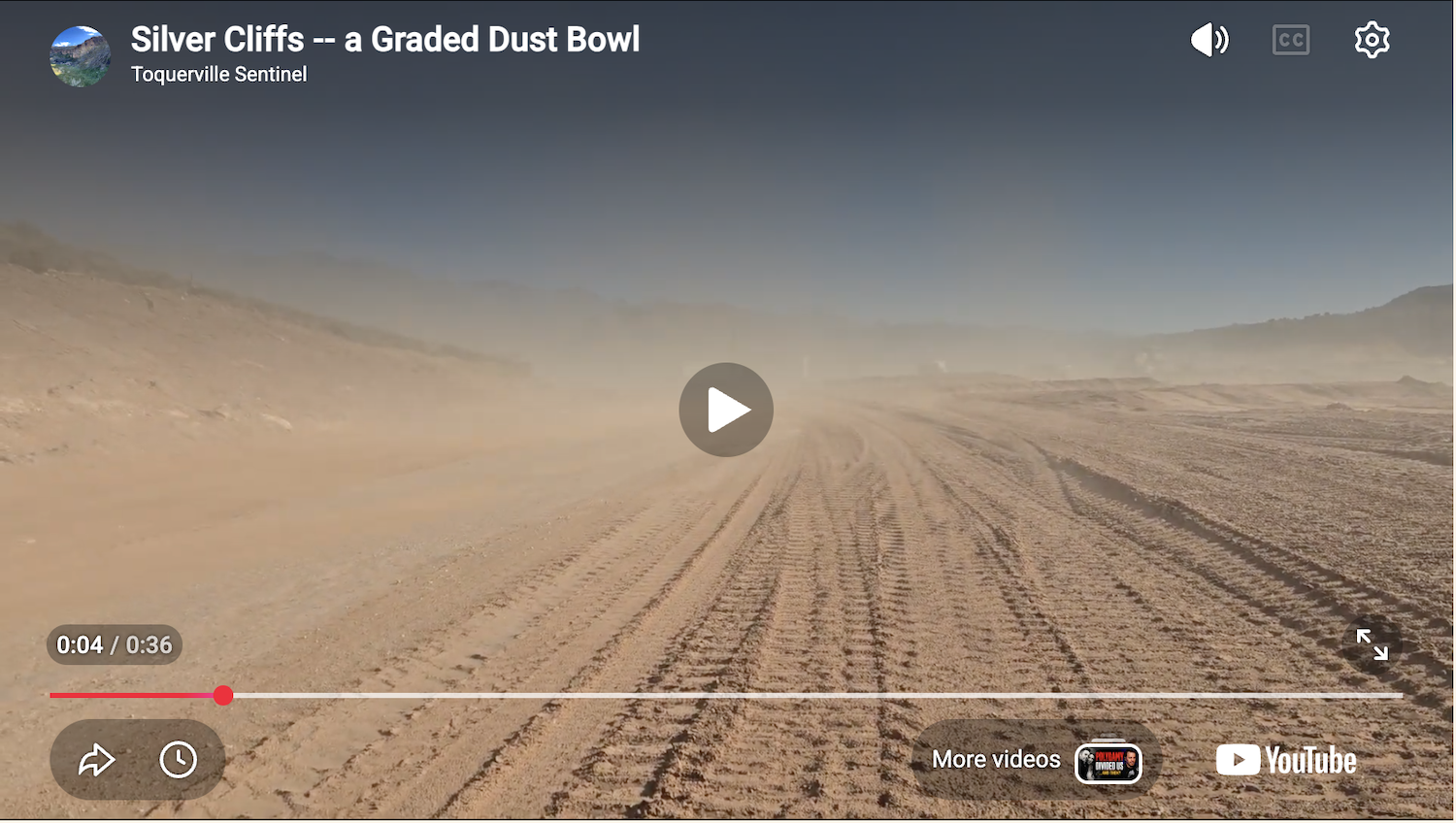
Screenshot of June 11, 2026 video (watch below) of Silver Cliffs excavation site adjacent to Red Cliffs conservation area (source: Leeds resident, Patrick Collins)
Utah is home to several major, dedicated (hyperscaler) data centers, including the National Security Administration's Bluffdale 100,000 sq foot facility for domestic surveillance and Meta's 1,000,000 sq foot Eagle Mountain facility. Shared (colocation) data centers also exist, including in St. George. Together, these facilities consume significant amounts of water, power, and land. The NSA Bluffdale facility uses an estimated 1.7 million gallons of water per day for cooling alone.
With the push for increased compute power to fuel artificial intelligence (AI), large data center projects are cropping up, disproportionately in drought-stricken communities where land, power, and water are often less expensive and data center regulation is lacking. This includes the recent high-profile Stratos project in Box Elder County, and the Antelope and Red Butte projects in Iron County. The heat, and air, light, and noise pollution released from these facilities further compound the environmental impacts.
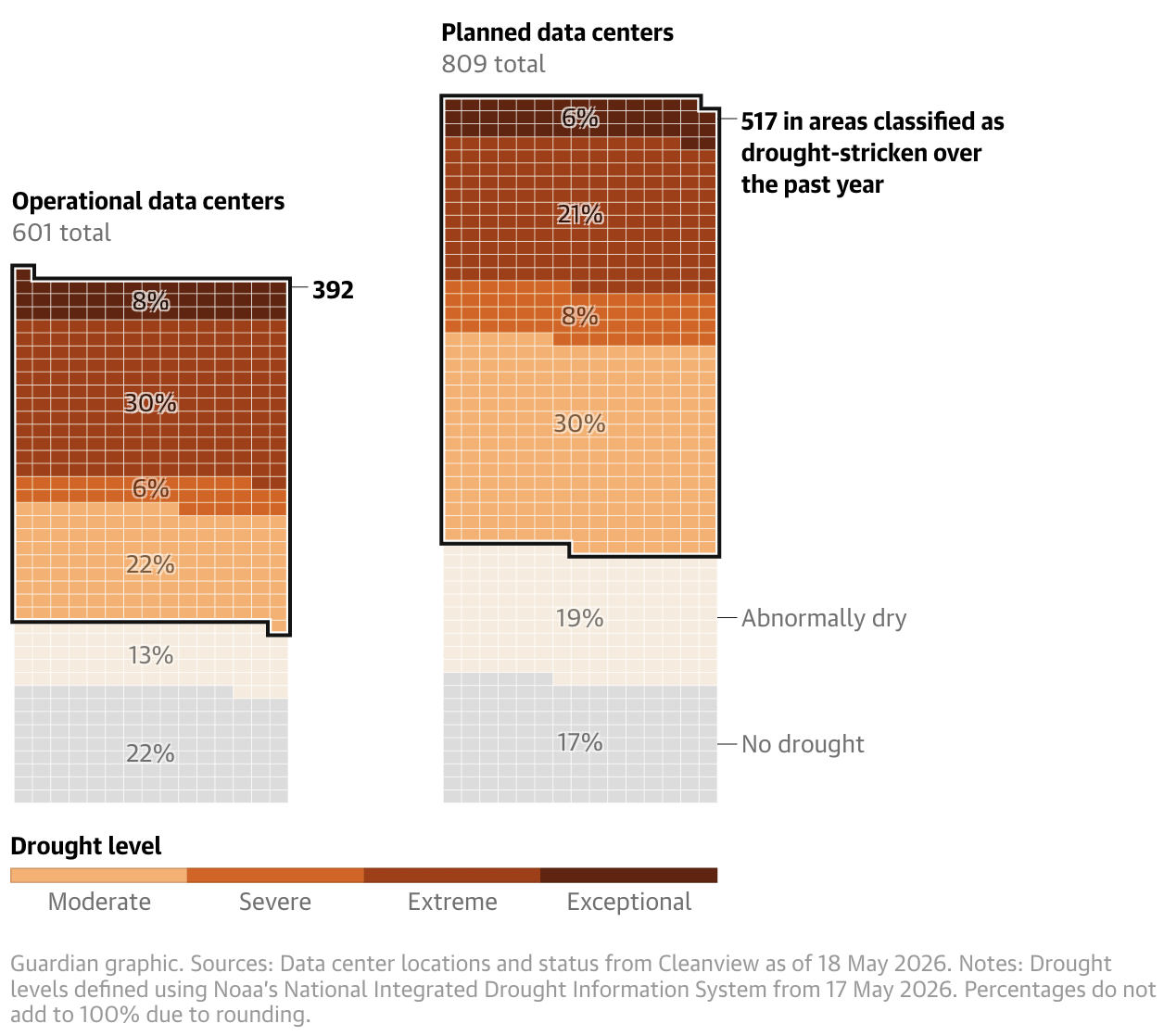
Major US data centers by location drought status (source: Guardian, 2026)
Power Grid Impacts
Not all data centers are built for AI workloads. AI workloads require specialized chipsets, like graphics processing units (GPUs), for efficient processing of large data sets. While GPU chips can operate at slightly warmer temperatures than older central processing units (CPUs), their thermal efficiency is offset by higher racking density.
Data centers require large amounts of electricity for processing and constant cooling to offset the heat produced by the servers. Due to contractual uptime guarantees, data centers also require redundant power, cooling, and networking to minimize outages. Backup power often comes in the form of noisy diesel or natural gas generators, although these methods are sometimes employed as primary power sources to expedite data center openings.
According to a 2024 Lawrence Berkeley Labs report prepared for the Department of Energy, US data center energy usage is expected to accelerate from 176 terawatt hours (TWh) in 2023 to as much as 452 TWh by 2028, enough power for on average 43 million homes. This increase in energy output requires significant investment into the electrical grid, at times with residential customers subsidizing the bulk of the infrastructure upgrades through higher utility rates and taxes.
Water Use
There are two broad categories of data center cooling: air-cooled and water-cooled. They are differentiated by how heat is expelled from the facility. Both systems use water or other liquid to absorb heat from the server area. Water-cooled facilities use cooling towers to expel this heat through evaporation; air-cooled facilities use air-cooled chillers with fans to expel the heat. Both types of systems use water and power to varying degrees, where decreased water draw means increased power consumption.
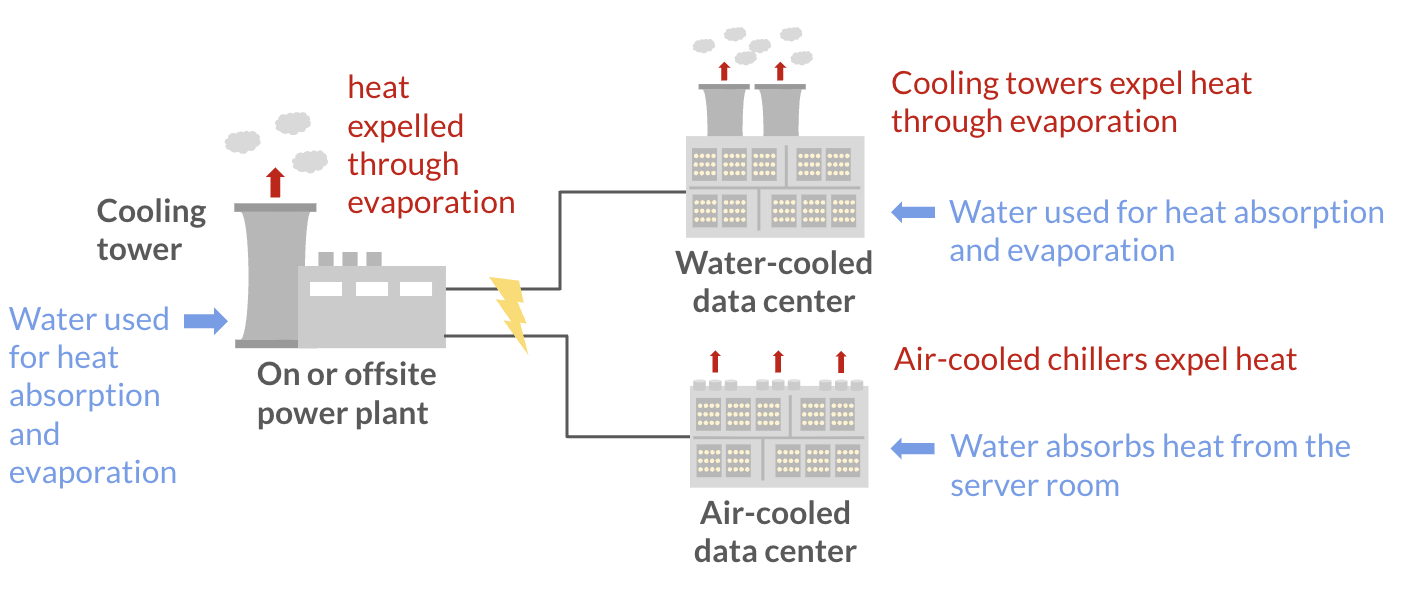
High-level water usage for power generation and data centers
Closed-loop cooling systems allow water (or other liquids) to be reused, reducing the heat exchange water demand by 50-70%. This, however, is offset by increased energy demand and subsequent high water volume required for power generation. Lastly, servers and chips can also be directly cooled rather than at the server room-level, resulting in greater water efficiency.
The rate of data center water consumption is already exceeding predictions made just a few years prior. For example, by 2030 it is now estimated that Texas data centers alone will use up to 399 billion gallons of water per year for cooling and power generation, up from 49 billion in 2025.
In March 2026, Utah passed HB 76, introducing water usage transparency amendments for new large (10,000+ square feet) data centers. While it's a step in the right direction, fines for noncompliance are inconsequential ($100 per day). It also did little to stop water-stressed counties from approving several new data centers amid major public backlash.
Other Environmental Impacts
The energy used by data centers is converted to heat, which is released as a byproduct into the surrounding environment. The phenomenon is known as heat islands, with global AI hyperscalers found to raise surrounding surface land temperatures on average 35 degrees Fahrenheit.
Fossil fuel-based power plants and backup generators contribute to air pollution in the form of sulfur dioxide (SO2), nitrogen oxides (NOX), particulate matter (PM), carbon dioxide (CO2), and mercury (Hg). Communities experience increased levels of noise and light pollution. Lastly, data centers often convert open space and wildlife habitat into inhospitable concrete jungles.
Societal Impacts
The US has relatively weak federal data privacy laws, and AI-driven data brokering, ad targeting, and surveillance are big business. The potential for deep fakes and malicious content is increasing. High profile hacks and data breaches have already occurred thanks to AI.
Job seekers are finding it increasingly difficult to find jobs due to AI resume screening, AI bot job interviews, and companies looking to use AI agents to justify downsizing jobs, often at the expense of product quality and safety.
Data center proponents frequently cite tax revenue and job creation as major benefits, but municipalities and counties sometimes offset revenue with tax incentives, and the environmental and infrastructure costs are often not factored into the cost benefit equation. Job creation is highly dependent on data center function, with rental-based colocation facilities seeing a net negative effect in permanent jobs over the longer term. Hyperscaler facilities tend to have a modest positive (3-4% average) impact on regional income. Paradoxically, colocation facilities received the largest share of tax subsidies.
Box Elder Data Center Application
The most recent, high-profile data center controversy is Box Elder County's approval of the 40,000 acre, 7.5 gigawatt (GW) AI hyperscaler project, known as the Stratos Project. Concerns around water and energy have been brushed off by the developers and the sole disclosed major investor, Canadian celebrity Kevin O'Leary. The developers are attempting to secure agricultural water rights, and the project includes a 9 GW natural gas power plant.
Because of the site's geography, Utah State University physics professor, Robert Davies, estimated that the excess heat from the data center and power plant, 16 GW in total, would raise the rural valley's temperature up to 5 degrees Fahrenheit during the day and 28F at night.
The proposed 9 GW natural gas power plant is estimated to consume 448 billion cubic feet of gas per year, 1.5 times more than the entire state of Utah for all uses, and 16.6 billion gallons of water per year. This is ~2.6 billion more than was used by all Washington County Conservancy District customers (2024 data). From an air pollution standpoint, the amount of nitrous oxide emissions would be approximately ~1,857 tons per year, five times double what is produced by Box Elder County industries today.
Despite significant public opposition, Box Elder County approved the project on May 4th after banning all public comment. Little did the public know, the approval was a formality, as the group managing the project is exempt from land use regulation.
The project has since been reduced to 20,000 acres after pressure from the President of the Utah state Senate, J. Stuart Adams, who demanded a 75% reduction in size, as well as environmental protections and increased transparency. Adams, who also chairs MIDA, had been facing public backlash during his primary campaign. The county has also paused new data center applications for 180 days pending data center zoning and regulatory review. The Stratos project is unaffected by the moratorium.
MIDA and PIDs
The Stratos project brought to light a mysterious state organization, known as the Military Installation Development Authority or MIDA, who is managing the project. Under public pressure, the State Auditor's office recently launched a Transparent Utah page for MIDA to provide visibility into its operations and finances.
According to the site, MIDA was formed in 2007 by the Utah legislature to take advantage of the Enhanced Use Lease law, which allows underutilized military land to be leased for civilian development. MIDA works closely with its lobbying arm, Utah Defense Alliance (UDA). Since 2021, MIDA revenue has skyrocketed, with fiscal year 2025 reaching revenues of $565 million.
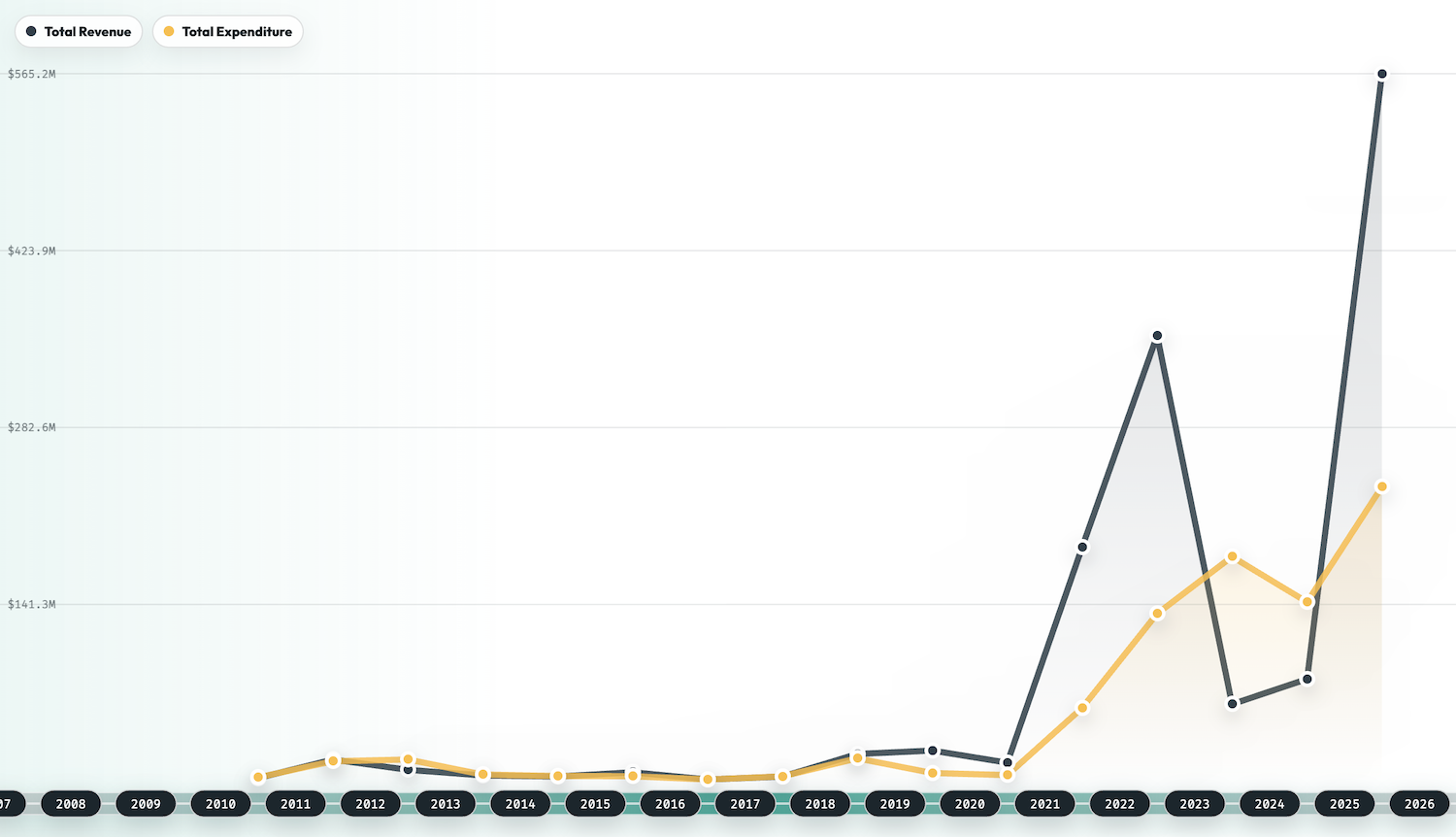
MIDA revenue and expenses by fiscal year (source: Utah State Auditor, 2026)
According to the Transparent Utah summary:
MIDA is a state-level governmental authority created to manage land use, issue bonds, and oversee economic development on underutilized military land. It functions as a "quasi-municipal" government with the authority to levy taxes and manage land use independently and without any other governmental oversight.
MIDA board members are appointed by the governor, and it uses public infrastructure districts (PIDs) for financing, land use regulation, and taxation. In other words, an unelected, profit-maximizing entity is left to self-regulate land use and taxation. Other concerns over PIDs include their lack of transparency and the potential to pass the risk onto municipalities should the project fail. The increasing use of PIDs prompted Utah state auditor, Tina Cannon, to issue a warning letter to municipalities in 2025.
MIDA's executive director and general counsel, Paul Morris, has also been involved in recent local developments in both Leeds (Silver Cliffs/Grapevine Wash) and Toquerville (Devil's Hole).
June 11, 2026 video of Silver Cliffs excavation site adjacent to Red Cliffs conservation area (source: Leeds resident, Patrick Collins). This video is also available on our Facebook page
Visitors to the Babylon region of the Red Cliffs National Conservation Area may be familiar with the developer's scorched earth removal of the vegetation adjacent to endangered desert tortoise habitat and the consequent dust storms.
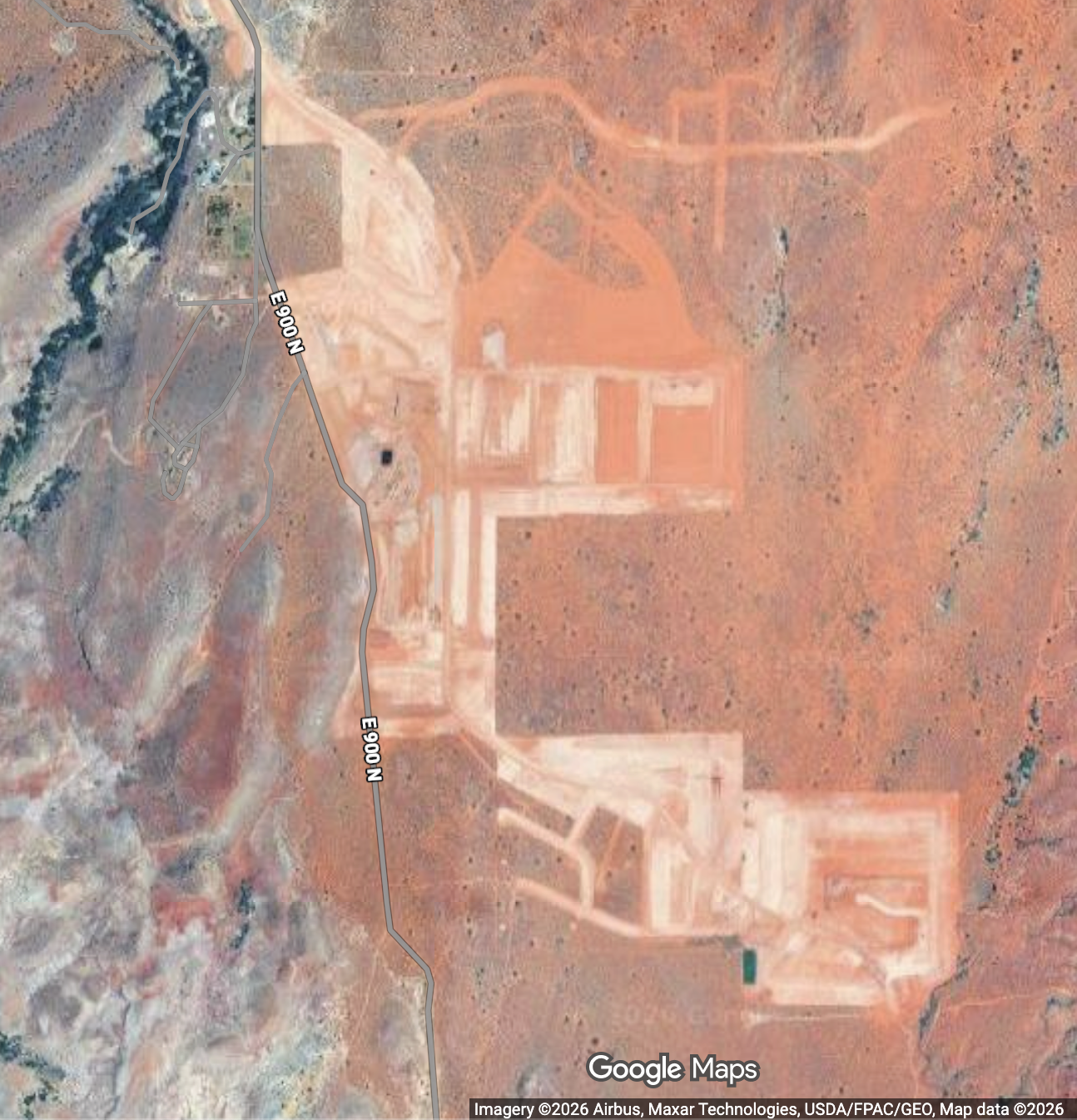
Silver Cliffs excavation site adjacent to Red Cliffs conservation area
(source: Google Maps and Maxar, 2026)
Iron County Data Center Proposals
On the heels of the Box Elder controversy, Iron County approved a conditional use permit for a 1.5 GW AI hyperscaler facility in Beryl, known as the Antelope Data Center. The facility will use an estimated 10-20 acre-feet of water during construction, 8 to fill the closed loop cooling system, and 8 annually for steady state operations. Perplexingly, the location was chosen in an area subject to a Groundwater Management Plan (GMP). The GMP was initiated due to the inability of the area's water users to maintain a safe yield of groundwater withdrawals.
Following the approval, a 180-day moratorium was placed on new data center application reviews. A second application remains on hold for the 1200-acre Red Butte Data Center, including a 1.5 GW power plant. This site is also in the water-stressed Beryl/Enterprise GMP zone.
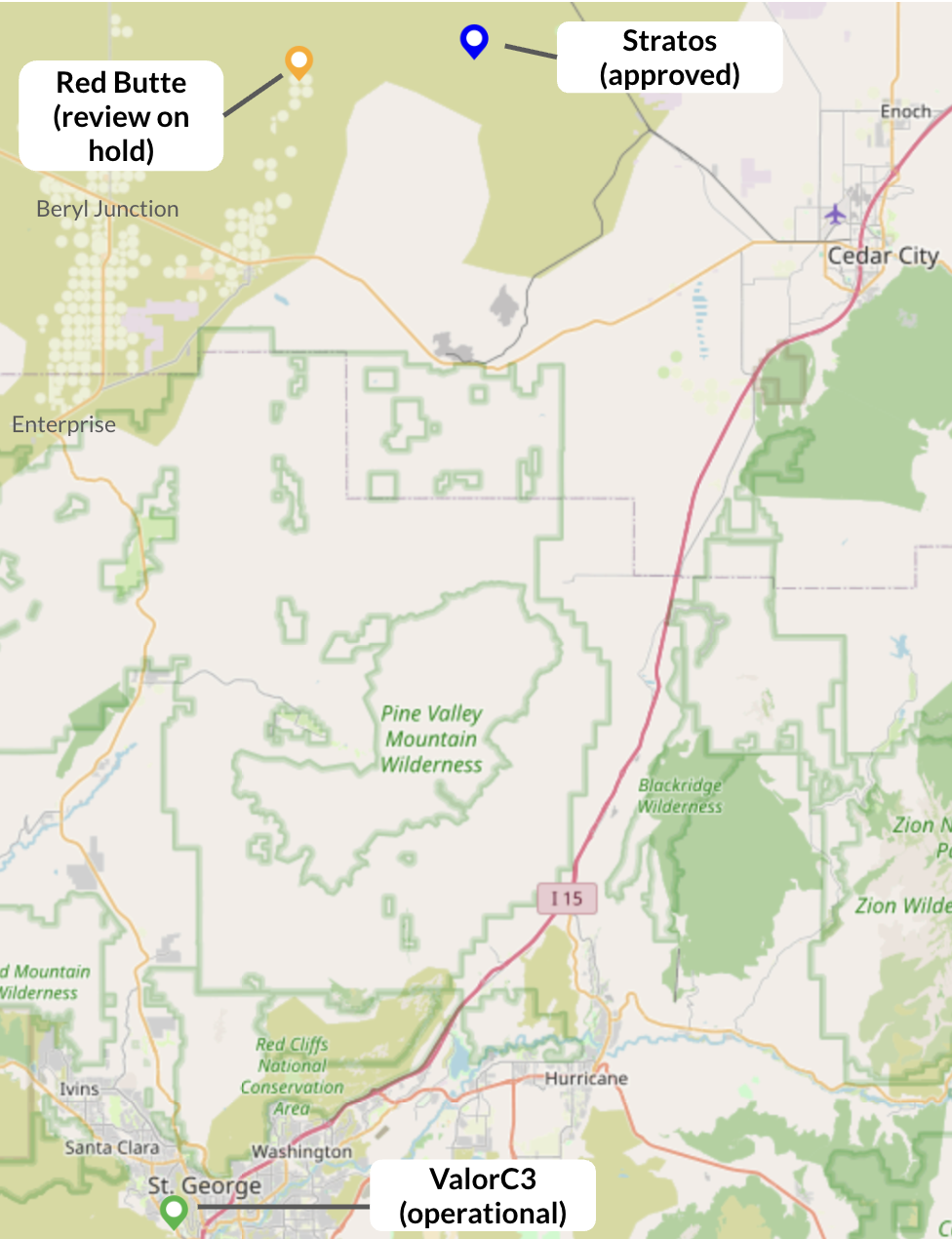
Washington and Iron County Existing and Proposed Data Centers
St George's ValorC3 Data Center
Saint George is home to the 30,000 square foot, air-cooled (CRAC), 4 megawatt (MW) ValorC3 Data Center, formerly known as Tonaquint, built in 2008. The site is a colocation facility, serving various clients. According to their strategic marketing profile, additional 5-10 MW data centers are planned for Utah, Idaho, and Nebraska, with future expansions to 16 other states. Details on proposed locations are not specified.
What You Can Do
The majority of new data center investment is targeted at AI. While you may not be able to stop all AI growth, you can be intentional about when and where you use the technology. It might take a little extra effort, but you can disable automatic AI functionality on your mobile phone and search engines (e.g. Google). Data privacy focused search engine, DuckDuckGo, even has a simple no AI search option. Consider whether you really need to use AI to create an image or help draft your email.
9 permanent data center bans are in place across the US, with 77 temporary ones, including Iron County. With the 2026 election in progress, find out candidates' stance on data center regulation and energy/water usage transparency. Write or call your congressional, county, and municipal reps to push for increased transparency and accountability. Keep an eye on public hearings for new data center applications.
Lastly, you can also vote with your bank account. Choose companies and nonprofits that practice ethical use (or non-use) of AI. For those who trade stocks or have mutual fund investments, you can choose to avoid AI technology companies. High profile, potentially risky, AI-driven IPOs recently went live or are expected for SpaceX, OpenAI, and Anthropic.
Data Center update — Sept 9, 2026
In June 2026 MIDA Board Chair and UT Senate President, Stuart Adams, lost his primary election, as did two of the Box Elder County Commissioners. Paul Morris, MIDA’s Executive Director, was also replaced with Dan Hemmert.
Stuart Adams has since threatened lawsuits against Utah Auditor Tina Cannon, conservative podcasters Uriah Kennedy and Ingrid Bettridge, and political operative Gabi Finlayson, alleging defamation and demanding retractions about data center-related criticism.
Should he proceed, Stuart is unlikely to succeed as Utah’s Public Expression Protections Act protects citizens against strategic lawsuits aimed at squashing public comment.