Solara Annexation at What Cost?
By Michelle Peot
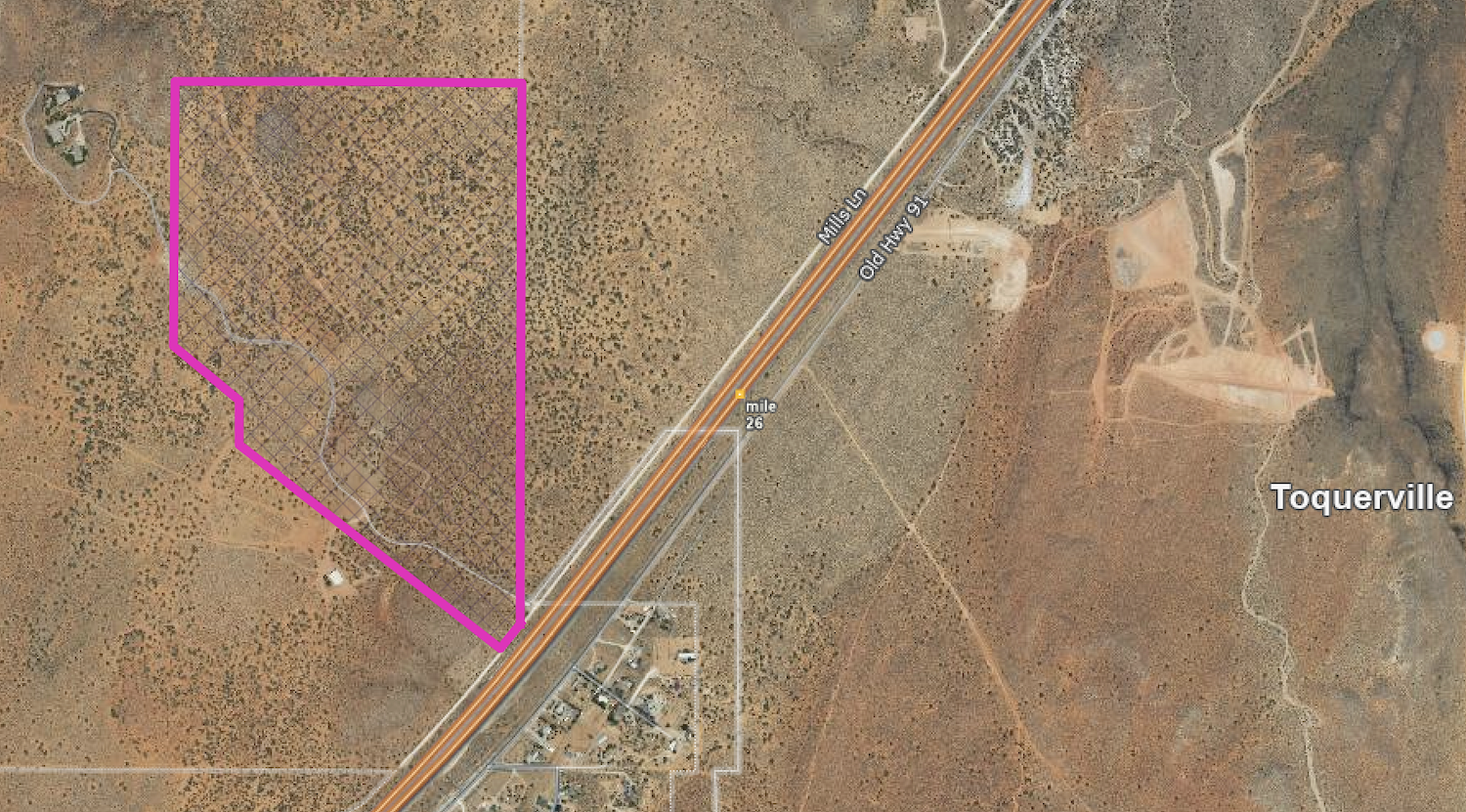
Location of parcel 3151-A-1-HV from Utah State Parcels
Since 2022, a large residential development has been floated for the north side of I-15, just southwest of Anderson Junction on parcel 3151-A-1-HV. The development was originally pitched in association with the failed ARC sports complex project by Frank Tusieseina of Eastward Project Management. Tusiseina defaulted on his $17.4 million loan, and the land was purchased by its financer SmartFi at public auction for $9 million. The residential development was rebranded as Solara. Annexation is being pursued with Toquerville after prior talks with Leeds fell through.
A scan of public records uncovered Tusieseina’s controversial past, including bankruptcies and alleged defrauding of investors. Tilton’s past is likewise problematic, from his delayed conflict of interest disclosure while he was in the Utah State House to the ongoing bankruptcy proceedings of his cryptocurrency-based financial services company, Power Block Coin, known publicly as SmartFi. SmartFi creditors allege that the company kept poor financial and business records, obscured financial holdings, and funneled their crypto assets into illiquid, unsecured, below market rate loans for Tilton's other businesses, including Solara.
The Chapter 11 trustee appointed by the court in May 2026 has since uncovered multiple, unauthorized and undisclosed instances of SmartFi further draining creditors’ assets after filing, in violation of bankruptcy law, as well as further evidence of inadequate financial traceability of customer assets. (June filing, July filing)
This appears eerily similar to the pattern at the disgraced cryptocurrency exchange FTX and its sister company, Alameda Research. It also begs the question: Why aren’t our public officials doing basic due diligence for projects with substantial fiscal and environmental impacts to our communities?
Who is Aaron Tilton, Solara’s Owner?
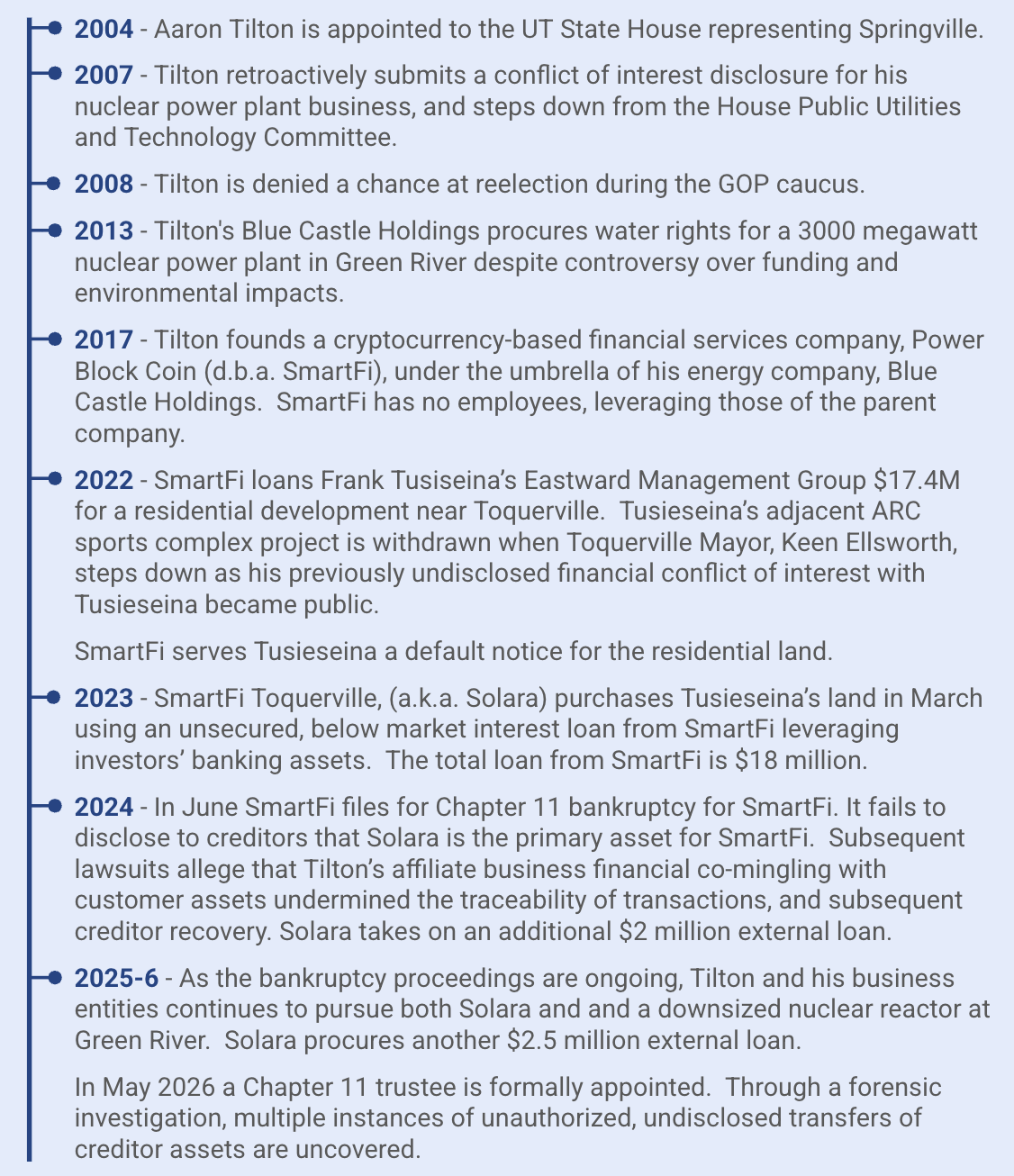
Timeline of Tilton's activities as documented in the public record
Utah State House and Nuclear Power Plant Controversy
Aaron Tilton is a former Utah State House Representative, who in 2007 stepped down from the House Public Utilities and Technology Committee over growing concerns about a financial conflict of interest arising from his attempts to both legislate and profit from nuclear power plants in Utah. As detailed in the Salt Lake Tribune in January 2008:
In October, Rep. Aaron Tilton, R-Springville, updated his conflict of interest statement to list his company that is seeking to get approval to build up to four nuclear power plants in Utah.
The disclosure came months after a committee he served on began discussion of nuclear power development proposals.
Five days after he filed the conflict notice, Tilton moved from his seat on a legislative committee considering a bill on nuclear power development to testify before the committee on his company's plans.
Tilton was denied a spot on the 2008 ballot by the District 65 GOP caucus.
Tilton's Blue Castle Holding company continued to pursue a controversial, 3000-megawatt nuclear reactor project near Green River. As reported by the Salt Lake Tribune in 2012, Tilton failed to inform the state that its purported $30 million hedge fund investor was never secured, nor that the firm, LeadDog Capital, was indicted and later convicted by the Securities and Exchange Commission for fraudulently misrepresenting investment liquidity (initial SEC decision). After a court battle with environmental groups, in 2013 water rights were procured for the plant.
Cryptocurrency-based Financial Services
In 2017 Tilton spun off a child cryptocurrency-based financial services company from Blue Castle Holdings, Power Block Coin (a.k.a. SmartFi), eventually expanding its scope to include small business and real estate loans, crypto exchange services, and banking. For consistency in this article, the public-facing name (d.b.a.) SmartFi will be used instead of its official legal name, Power Block Coin LLC, and public-facing Solara is used as shorthand for SmartFi Toquerville and Solara Communities LLC. Both combinations of names appear in legal documents.
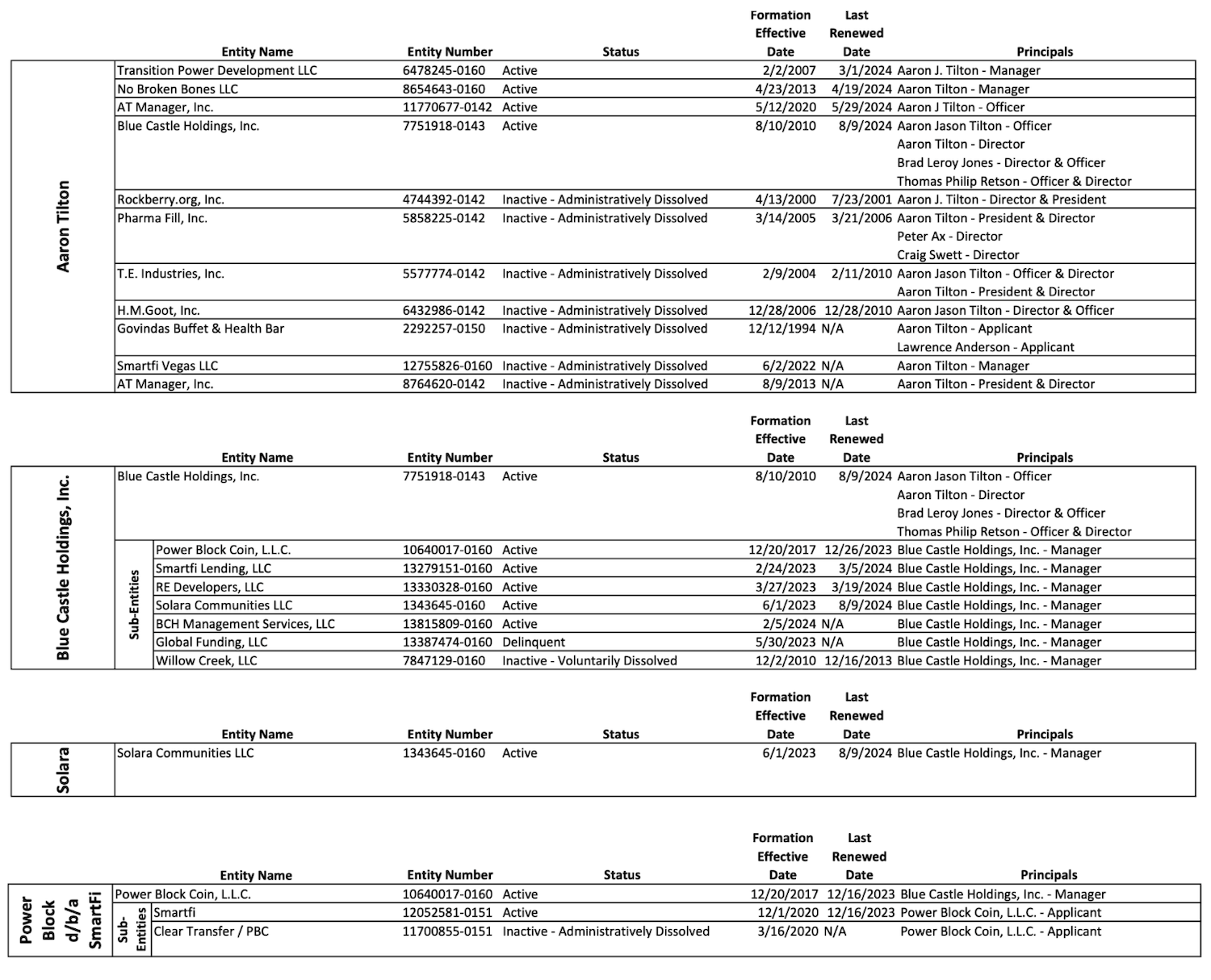
Overview of Tilton’s business entities from the court filing (original exhibit)
Origin of Solara
The original residential project on the Toquerville site was Zions Landing, managed by developer Frank Tusieseina. Tusieseina has a controversial past, involving bankruptcies and allegations of investor fraud. In September 2022 former Toquerville Mayor, Keen Ellsworth, stepped down as his undisclosed financial conflict of interest with Tusiseina’s development company became public. Ellsworth was pursuing Toquerville’s sponsorship of Bureau of Land Management land acquisition for Tusieseina’s adjacent, for-profit, private sports complex and charter school, in violation of federal law.
Perplexingly, Tusiseina received a loan from SmartFi. In October 2022, Zions Landing was provided a notice of default (click Public Login to view link) on behalf of SmartFi. In March 2023 the property was purchased by SmartFi Toquerville at public auction, and the development and business entity were rebranded as Solara. Another Tilton owned LLC, RE Developers, is currently handling property development.
Chapter 11 Bankruptcy and Alleged Financial Irregularities
SmartFi filed for Chapter 11 bankruptcy in June 2024. According to the Chapter 11 bankruptcy judicial Memorandum Decision from October 2024, Tilton’s various business entities are financially inter-related and controlled by him, with SmartFi serving as an unbanked financial holding company staffed by Blue Castle Holdings employees and consultants at a 10% markup under its Management Services Agreement.
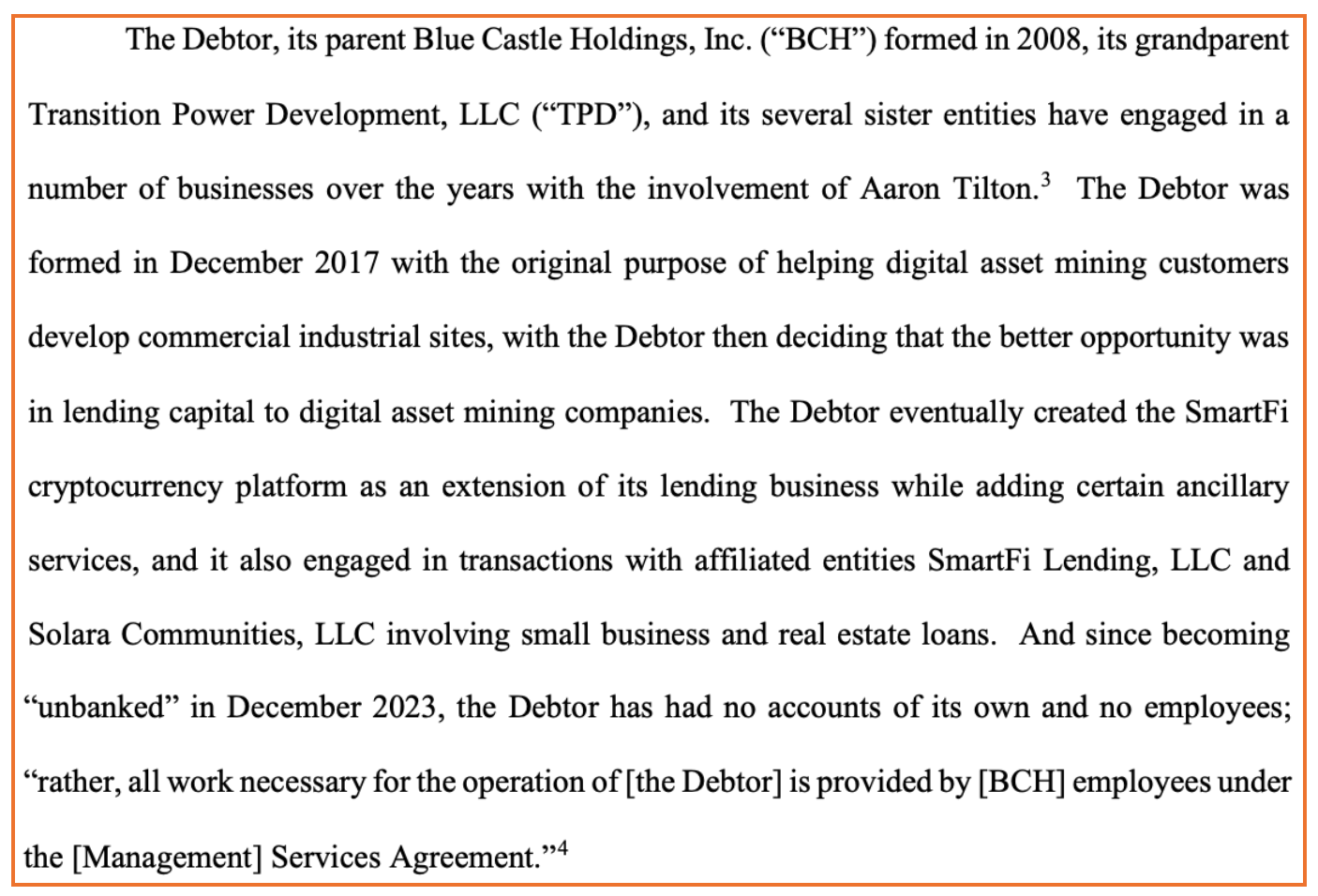
Excerpt from the 2024 Memorandum Decision
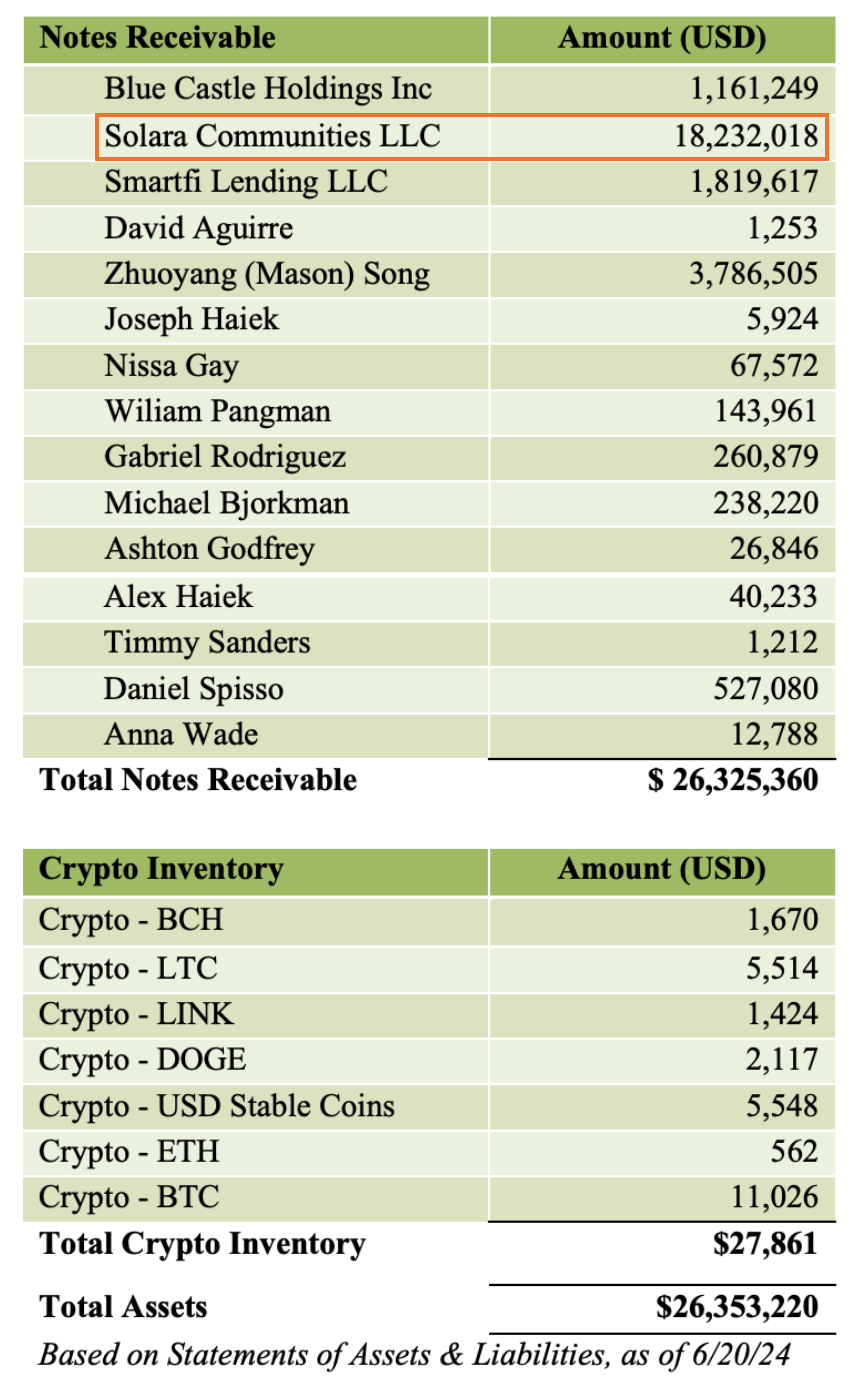
As outlined in the 2025 Combined Chapter 11 Plan and Disclosures Statement by the Official Committee of Unsecured Creditors, SmartFi’s assets amount to $26.3 million in notes receivable, $18.2 million of which is Solara, and $27,900 is cryptocurrency. Liabilities include $1.7 million from debtor-disclosed individuals and $192.5 million from post-petition claimants.
Image left: SmartFi assets as excerpted from the Combined Chapter 11 Plan and Disclosures Statement
The committee goes on to allege that SmartFi used customer investments to make large, unsecured loans to Tilton-controlled affiliate entities at below market rates, including Solara. No payments were due until loan maturity, 10 years in Solara’s case. The creditor committee also raised concerns about the failure of Tilton to disclose the existence of Solara, SmartFi’s primary asset.
The committee also raised concerns over Solara taking on an additional $2 million external loan on the property after declaring bankruptcy, further undermining the likelihood of creditor compensation, and the failure to disclose this loan as required. Despite this, in April 2026 the loan amount was amended to $4.5 million (Click Public login).
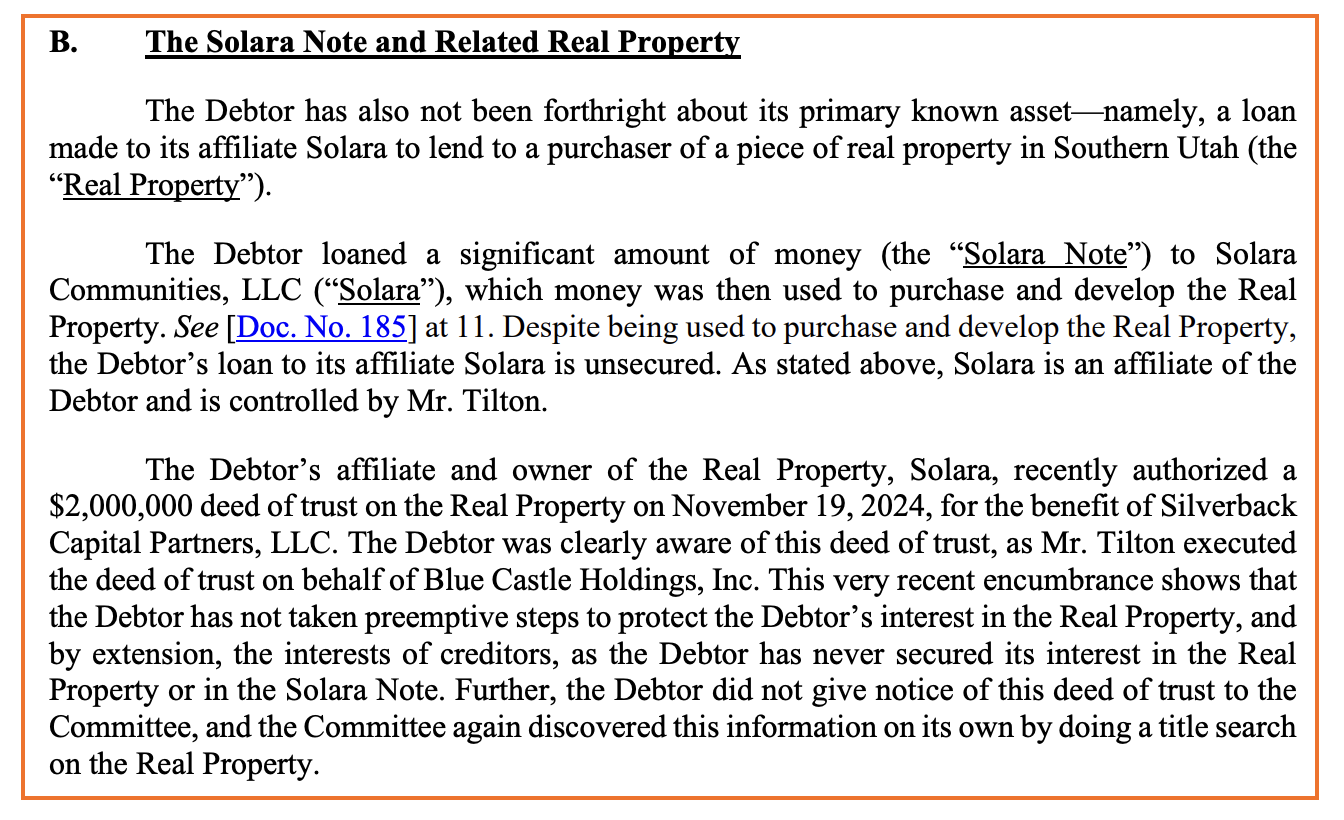
Excerpt from the Combined Chapter 11 Plan and Disclosure Statement
Lastly, the committee also noted that SmartFi failed to provide the committee with sufficient and complete financial and business records to conduct a full liquidation analysis. Several investors sued, alleging fraudulent representation of investment liquidity. In March 2025, SmartFi's request to dismiss the civil suit was denied.
In the March 2026 Memorandum Decision for remaining in Chapter 11 and formally appointing a trustee, the judge cited SmartFi’s failure to comply with the court’s order for strict record keeping in financial transfers between SmartFi and Blue Castle Holdings. In May a Chapter 11 Trustee was named.
On June 24th, newly appointed Trustee, Angela J. Somers filed a complaint against Tilton, part-time SmartFi CFO/CPA Brad Ford, and Coinbase to recover an unauthorized, post-bankruptcy transaction made by SmartFi to secretly divert $240,000 of crypto assets into Coinbase wallets Tilton and Ford personally controlled. The transaction was uncovered through a forensic investigation. Trustee Somers called the move “a brazen act of insider self-dealing”. She went on to state:
Mr. Tilton and Mr. Jones sought and received the protections provided under the Bankruptcy Code under the conditions that the Debtor preserve all remaining assets for equitable distribution among actual customers. But they then did the opposite. They promptly turned around and drained the estate of nearly all its remaining value.
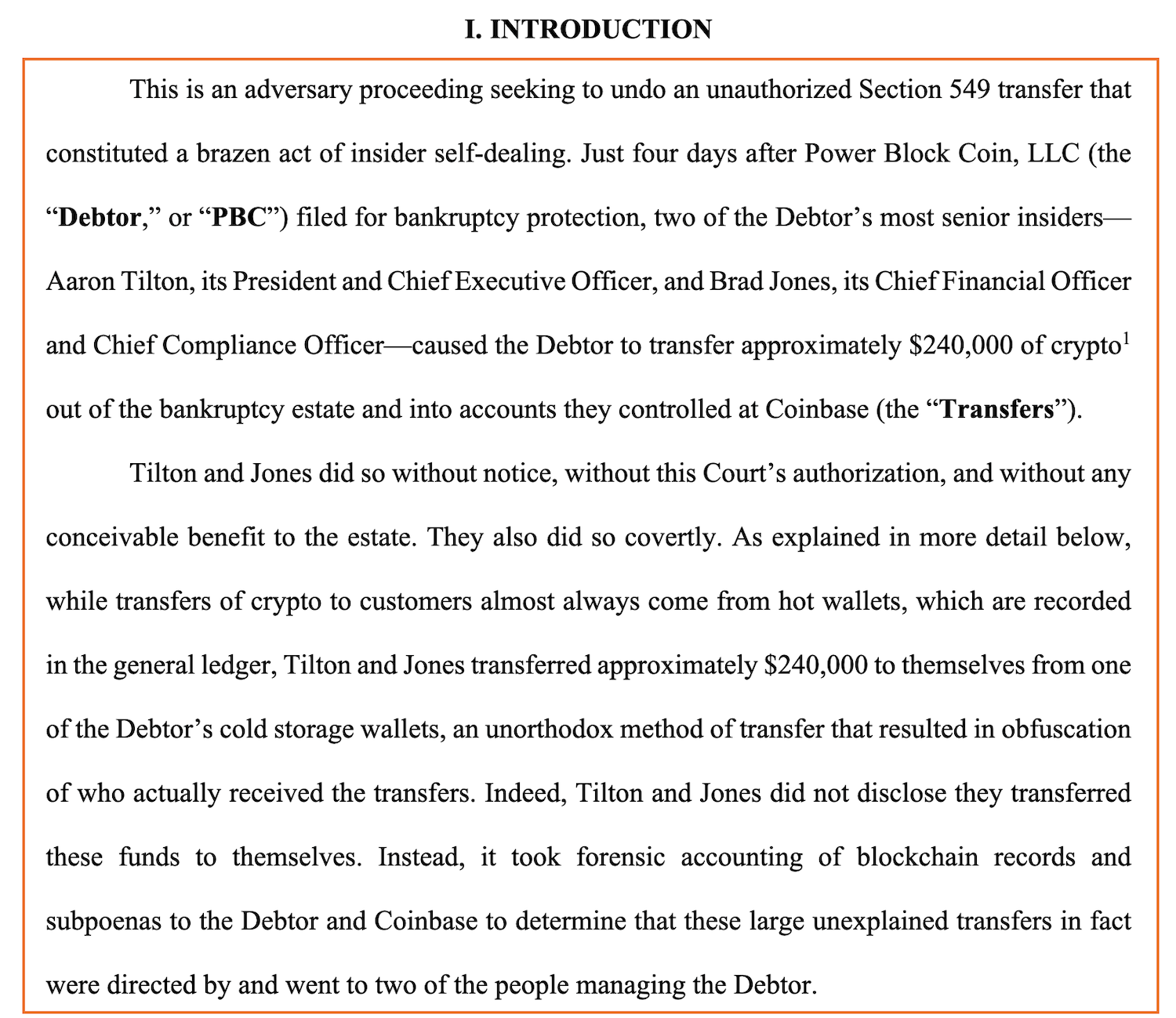
Excerpt from Complaint to Avoid and Recover Unauthorized Post-petition Transfers
In July, Trustee Somers filed a second similar complaint to recover $136,439 from a Coinbase wallet controlled by Jose Sarti, which was likewise transferred without authorization after the bankruptcy filing. Sarti was not listed as a creditor in the bankruptcy filings.
Despite the ongoing bankruptcy proceedings, Tilton continues to pursue Solara and a revised nuclear power project in Green River. Toquerville City Council also continues to entertain annexation of the Solara property in spite of resident opposition and a Planning Commission vote of 3-2 against annexation.
Reform is Long Overdue
Returning to our original question: Why aren’t our public officials doing basic due diligence for projects with substantial fiscal and environmental impacts to our communities? We live in a state where short-term financial incentives reign supreme, often at the expense of our communities, the environment, and longer-term fiscal return on investment. The state's conflict of interest rules are weak, and transparency and accountability are lacking.
Development pressures are high in our area, but that doesn’t mean we need to move forward at all costs. When a developer approaches a municipality or the county for a project costing tens of millions, why shouldn't they be subject to the same background check policies that govern a consumer car loan or a home mortgage? These projects take significant public resources for review and oversight, and municipalities and counties are pressured to expend millions in taxpayer dollars to subsidize infrastructure to bear the burden of the additional homes and absorb the future impact of its residents.
For example, as reported at the August 4, 2025 Washington County Conservancy District meeting, Solara received a $2 million grant for water infrastructure, which the District requested from the state for this project. Prolonging this engagement reduces the likelihood of swift reimbursement for the bankruptcy creditors. Should this project fail midstream, communities could be left with barren landscapes and a dust bowl. The Conservancy District was firm on limiting water service to 74 homes unless Solara was annexed into Toquerville. A less risky solution would be for Toquerville to hold off on annexation until a proven, less controversial developer acquired the property.
We have laws that require disclosure of conflicts for public officials, but recusal from related decisions is voluntary and those that violate disclosure rules often face no penalties. For Washington County elections, campaign contribution disclosures can't be submitted more than 14 days before an election and the deadline is 7. How is that sufficient time for voters to assess potential future conflicts?
Citizens and public employees have little recourse once a likely ethics violation occurs. The state's Ethics Commission is made up of a small group of volunteers. The bar is high for submitting complaints, and at times citizens have been discouraged by the ethics office from filing.
Lastly, rather than learning from mistakes, controversies like the ARC sports complex are swept under the rug. Amid the ARC sports complex controversy, former Mayor Ellsworth was hired by the Hurricane Valley Fire District as their business manager. Less than 2 years later, he was no longer employed by the district after being indicted by the US Department of Justice as an alleged co-conspirator in an unlicensed, cryptocurrency-based money laundering business, where Ellsworth allegedly used his business for financial transfers. As we head into the fall midterm election, consider the consequences of your vote.
Solara Annexation update — Sept 9, 2026
Since this report was written, the SmartFi Chapter 11 Trustee filed a complaint against Fitz Cange to recover $29,751 in assets that SmartFi improperly transferred after filing for bankruptcy. Through an ongoing forensic investigation, the complaint also details SmartFi’s systematic practice of co-mingling customer crypto wallets and operating assets to avoid transaction fees. This resulted in lack of transparency of ownership and transactions.
Additional information was also uncovered on Tilton’s data center project. Blue Castle Holdings (BCH) made agreements with Kane and San Juan Counties to lease water for the Green River nuclear reactor. In 2023, Blue Castle defaulted on the first payment to the water districts. San Juan County canceled the leasing agreement. This May Fulcrum Point Holdings, a subsidiary of Hi Tech Solutions, announced a partnership with Blue Castle. Significant financial and regulatory hurdles remain.
In order to better understand why there hasn’t been more pushback on Tilton’s projects, state and Washington County campaign finance data was analyzed using public records. Tilton and his business entities have given a total of $44,250 to various state candidates, mostly during the 2010s. The largest total donation ($10,000) went to Gary Herbert, Utah’s governor from 2009 to 2021, with current governor Spencer Cox serving as the lieutenant governor from 2013 to 2021. No donations appeared for Spencer Cox or the current Washington County Commissioners. It’s possible that additional donations occurred through political action committees, but these aren’t publicly searchable.
Toquerville has voted to accept Solara’s annexation petition.